Tools
From documents to argument.
Auto chronology, gap detection, deterministic calculators and hearing reminders — the tools that turn a pile of documents into an argument you can make in court.
Auto chronology — the case in order
Every document in the matter is read, dated and placed in a timeline. The medico-legal certificate goes in on the date of examination. The FIR goes in on the date of the accident. The discharge summary sits between admission and discharge. Prior tribunal orders appear in the sequence they were passed.
Where a document carries no explicit date — a handwritten note, a prescription without a printed date — NRD infers the date from context where possible and flags it as inferred rather than presenting it as exact. The timeline shows you what is known and what is an estimate.
The chronology is readable in the matter view and exportable as a PDF. Most lawyers find it useful both for drafting the claim petition and for oral argument — it makes the sequence of events plain to a tribunal that has not lived with the file the way you have.
Missing-doc detection — per-claim-type, not generic
NRD checks what is in the file against the checklist for this specific claim type. A fatal motor accident claim needs a post-mortem report, a death certificate, proof of dependency and an FIR. A permanent partial disability claim needs a disability certificate from a competent authority, proof of income and an employment letter. The checklist is not the same for both.
The gap report tells you: what is present, what is present but of poor quality (illegible, incomplete, wrong format), and what is absent. For each absent document, NRD tells you where to get it and whether a retrieval request has already been sent.
The checklist is based on the standard evidentiary requirements for MACT and motor TP claims in India. It reflects what tribunals ask for, not what is easy to collect. If a document is routinely ignored in your jurisdiction, you can mark it as not applicable — NRD will stop flagging it for future matters.
Deterministic calculators — exact, not estimated
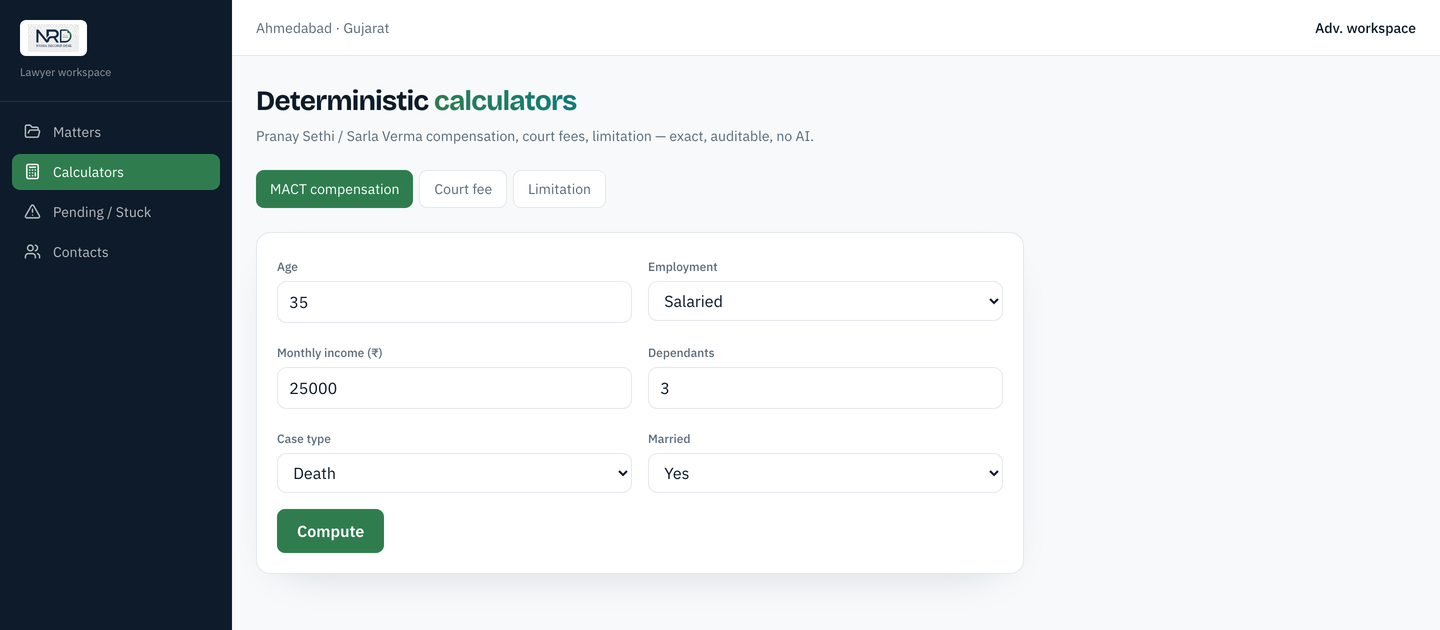
The MACT compensation calculator applies the Supreme Court's Pranay Sethi formula — the authoritative method for structured damages in motor accident claims — to the numbers in the file. Age, income, dependency fraction, disability percentage, multiplier: all drawn from verified documents and computed exactly.
The result is not a range or an estimate. It is the figure that follows from the formula applied to the evidence. If a document is missing or unverified — say, the income figure is from an affidavit without corroborating employer confirmation — the calculator flags the uncertainty and shows both the conservative and the supported figure.
Limitation date calculation works the same way: the relevant section of the Limitation Act, the date of accident, the date of majority (for minors), any period of legal disability — calculated exactly, not approximated. Court fee calculation uses the current schedule for the relevant tribunal.
These calculators are exact by construction: they apply fixed legal rules (Pranay Sethi, limitation periods, court-fee schedules) to the inputs you give. The only source of error is the inputs themselves — and NRD shows you the quality of each input so you know where to look if the number seems off.
Hearing reminders — eCourts-synced, WhatsApp-delivered
NRD pulls hearing dates directly from eCourts using the CNR number for each matter. When a hearing is listed, or when a date is updated by the tribunal, the matter view reflects it without any manual entry.
Reminders go to your WhatsApp number: 7 days before (so you can brief the client and prepare), 1 day before (so you can confirm your travel and preparation), and 2 hours before (so you have the time and courtroom in front of you). You choose which reminders you want.
If eCourts shows a date that conflicts with a date already in the system — because the matter was adjourned verbally and no digital update was posted — the discrepancy is flagged. You see both dates and confirm which is correct. Tribunal systems are not always up to date; NRD tells you when they disagree with what you know.
Calculator reference
| Calculator | Method | Accuracy | Inputs required |
|---|---|---|---|
| MACT compensation | Pranay Sethi formula (SC 2017) | Deterministic | Age, income, disability %, dependency, multiplier |
| Limitation date | Limitation Act 1963 / MV Act | Deterministic | Date of accident, date of majority, disability periods |
| Court fees | Tribunal fee schedule (state-specific) | Deterministic | Claim amount, tribunal, state |
Deterministic = exact output from fixed rules applied to verified inputs. Accuracy depends on input quality; NRD shows input confidence for each field.
Start sending records.
We'll run the calculators on your first matter and show you the gap report before you commit to anything.